
Introduction
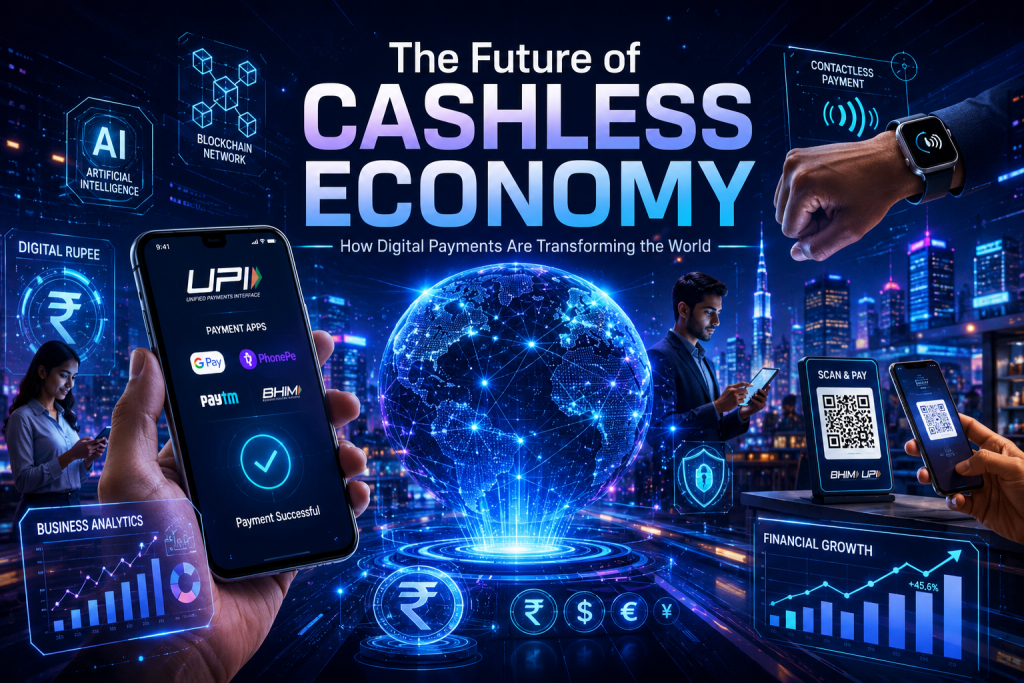
The global financial system is rapidly changing as countries move toward a cashless economy powered by digital transactions and smart technologies. Mobile banking, QR code payments, artificial intelligence, blockchain, and fintech innovations are reshaping how people send, receive, and manage money.
Today, consumers can purchase products, transfer money, pay bills, invest, and access financial services directly from smartphones without carrying physical cash. This transformation is creating a faster, smarter, and more connected financial ecosystem.
Countries like India, China, Sweden, and Singapore are leading the digital payment revolution. In India, the rise of UPI has made digital payments simple and accessible for millions of users, including small businesses and rural populations.
The future of the cashless economy will not only change banking systems but also redefine commerce, governance, security, and everyday life.
What is a Cashless Economy?
A cashless economy is a system where financial transactions are mainly conducted through digital methods instead of physical money.
Common digital payment methods include:
- Mobile wallets
- Debit cards
- Credit cards
- UPI payments
- Internet banking
- Contactless payments
- QR code payments
- Digital currencies
In a cashless society, people rely on technology-based payment systems for daily transactions.
Evolution of Digital Payments
Digital payments have evolved significantly over the past two decades.
Earlier, people depended mostly on cash and traditional banking services. Later, debit cards and online banking introduced electronic transactions. The rise of smartphones accelerated the growth of digital wallets and instant payment apps.
Today, advanced technologies like AI, blockchain, biometric authentication, and cloud computing are transforming financial systems globally.
The COVID-19 pandemic also accelerated contactless payment adoption as consumers preferred safer and faster transaction methods.
Why the World is Moving Toward Cashless Transactions
Several factors are driving the shift toward a cashless economy:
- Increased smartphone usage
- Faster internet connectivity
- Growth of e-commerce
- Government digital initiatives
- Demand for convenience
- Contactless payment systems
- FinTech innovation
Consumers now prefer quick and secure payment methods that simplify everyday financial activities.
Role of Smartphones and Internet
Smartphones have become digital wallets for millions of users worldwide.
People can now:
- Transfer money instantly
- Pay utility bills
- Shop online
- Invest digitally
- Access mobile banking services
Affordable internet access and expanding 5G networks are further boosting digital payment adoption.
UPI and India’s Digital Payment Revolution
India has emerged as one of the world’s leading digital payment markets due to the success of the Unified Payments Interface (UPI).
UPI allows instant bank-to-bank transfers using mobile phones and QR codes. It has transformed the Indian payment ecosystem by making digital transactions easy, fast, and free for users.
Today, even small vendors, local shops, and street sellers accept UPI payments.
India’s Digital India initiative and affordable internet services have accelerated financial inclusion across urban and rural regions.
Artificial Intelligence in Banking
Artificial Intelligence is transforming the banking and finance industry.
AI-powered systems help banks:
- Detect fraud
- Analyze spending behavior
- Improve customer support
- Automate financial services
- Offer personalized banking recommendations
In the future, AI may function as a personal financial advisor that helps users manage budgets, savings, investments, and expenses automatically.
Blockchain and Digital Currency
Blockchain technology enables secure, decentralized, and transparent transactions.
Cryptocurrencies such as Bitcoin introduced blockchain to the world, but governments and banks are now exploring broader applications such as:
- Cross-border payments
- Smart contracts
- Secure settlements
- Digital identity systems
Blockchain can reduce transaction costs and improve transparency in financial systems.
Future of CBDCs and Digital Rupee
Central Bank Digital Currencies (CBDCs) are digital versions of national currencies issued by central banks.
Countries around the world are developing CBDCs to modernize payment infrastructure.
India’s digital rupee initiative is expected to improve:
- Payment efficiency
- Financial inclusion
- Welfare distribution
- Cross-border transactions
CBDCs may become a major part of future global finance.
Benefits of a Cashless Economy
Faster Transactions
Digital payments are quicker than cash transactions and reduce waiting times.
Better Financial Transparency
Electronic transaction records improve accountability and reduce corruption.
Increased Financial Inclusion
Digital banking services can reach remote and underserved populations.
Reduced Crime
Cashless systems reduce risks related to theft, robbery, and counterfeit currency.
Lower Operational Costs
Governments and banks save money by reducing currency printing and cash management expenses.
Challenges and Risks
Despite many advantages, the cashless economy also faces challenges.
Cybersecurity Threats
Hackers and cybercriminals target digital financial systems.
Privacy Concerns
Digital transactions create data trails that may affect user privacy.
Digital Divide
Not everyone has equal access to smartphones, internet, or digital literacy.
Technical Failures
Power outages or internet disruptions may temporarily affect digital payments.
Cybersecurity in Digital Finance
Strong cybersecurity systems are essential for protecting digital transactions.
Future financial systems may use:
- AI fraud detection
- Biometric authentication
- Multi-factor security
- Blockchain encryption
Consumers must also stay aware of online scams and phishing attacks.
Impact on Businesses and Consumers
Businesses benefit from digital payments through:
- Faster billing
- Better customer experience
- Online market expansion
- Data-driven marketing
Consumers benefit from convenience, speed, and easier access to financial services.
The rise of fintech companies is also increasing innovation in digital finance.
Future Trends in Digital Payments
Future payment systems may include:
- Voice-based payments
- AI financial assistants
- Biometric transactions
- Smart wearable payments
- Offline digital currency systems
- Cross-border instant payments
Digital transactions will become increasingly automated and seamless.
Smart Cities and Invisible Payments
Future smart cities may integrate transportation, healthcare, shopping, and utilities into unified digital ecosystems.
“Invisible payments” will allow transactions to happen automatically without requiring manual payment steps.
Examples include:
-
- Automatic toll payments
- Smart retail checkout systems
- Subscription-based automated services
Will Physical Cash Disappear Completely?
Physical cash may not disappear entirely in the near future, but its usage will likely decline significantly.
Some populations still depend on cash due to limited digital access or personal preference.
Most experts believe future economies will become “less-cash” rather than fully cashless.
Future of India’s Cashless Economy
India is expected to remain a global leader in digital finance innovation.
Future developments may include:
-
-
- AI-powered banking
- Digital rupee expansion
- Voice payments in regional languages
- Global UPI systems
- Smart financial ecosystems
-
India’s growing fintech ecosystem is likely to play a major role in shaping the future of digital payments worldwide.
Conclusion
The future of the cashless economy represents a major transformation in global finance and technology. Digital payments are becoming faster, safer, and smarter through innovations such as artificial intelligence, blockchain, biometric authentication, and central bank digital currencies.
A cashless society offers many advantages, including convenience, transparency, financial inclusion, and improved efficiency. However, cybersecurity, privacy protection, and digital accessibility remain important challenges.
As countries continue investing in digital infrastructure and financial innovation, the world is moving toward a future where digital transactions become a normal part of everyday life.
The cashless economy is not just about replacing physical money — it is about creating a connected, intelligent, and technology-driven financial ecosystem for the future.
Frequently Asked Questions (FAQs)
1. What is a cashless economy?
A cashless economy is a system where most financial transactions are conducted digitally instead of using physical cash.
2. Why is the world moving toward cashless payments?
The world is adopting digital payments because they are faster, more convenient, secure, and efficient than traditional cash transactions.
3. What is UPI?
UPI (Unified Payments Interface) is an instant digitalpayment system developed in India that allows direct bank-to-bank transfers using smartphones.
4. Is a cashless economy safe?
A cashless economy can be safe if strong cybersecurity systems, encryption, and fraud detection technologies are implemented properly.
5. What are the biggest risks of a cashless economy?
Major risks include cybercrime, data privacy concerns, digital fraud, internet dependency, and unequal digital access.
6. Will cash disappear completely in the future?
Cash may continue to exist, but digital payments are expected to dominate future financial systems.
7. What role does AI play in digital banking?
AI helps banks detect fraud, automate customer service, personalize financial recommendations, and improve transaction security.
8. What are CBDCs?
CBDCs (Central Bank Digital Currencies) are digital versions of national currencies issued and regulated by central banks.
9. How does blockchain help digital payments?
Blockchain improves transaction security, transparency, and efficiency by using decentralized digital ledgers.
10. Why is India leading the digital payment revolution?
India’s success is driven by UPI, affordable internet access, government digital initiatives, and widespread smartphone adoption.